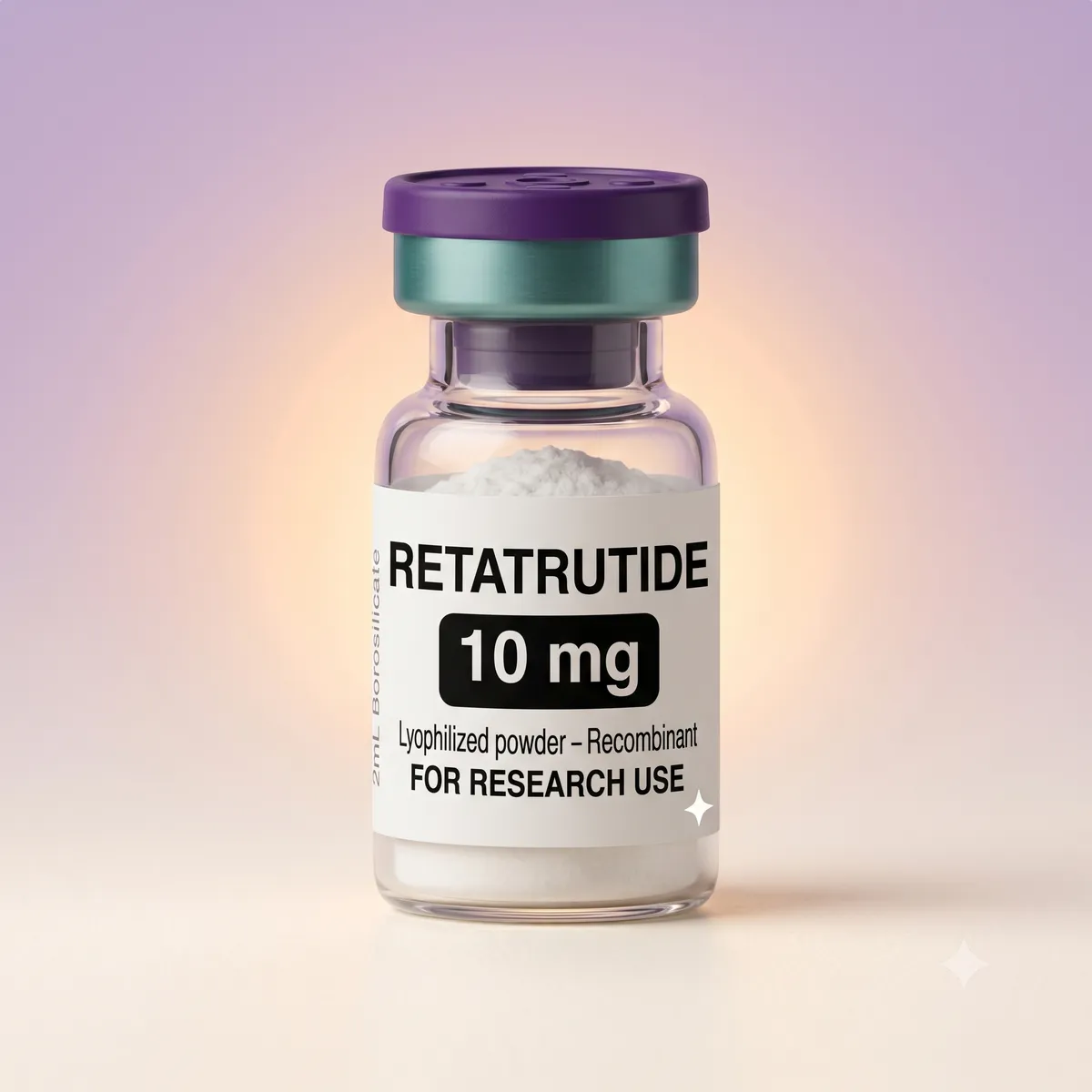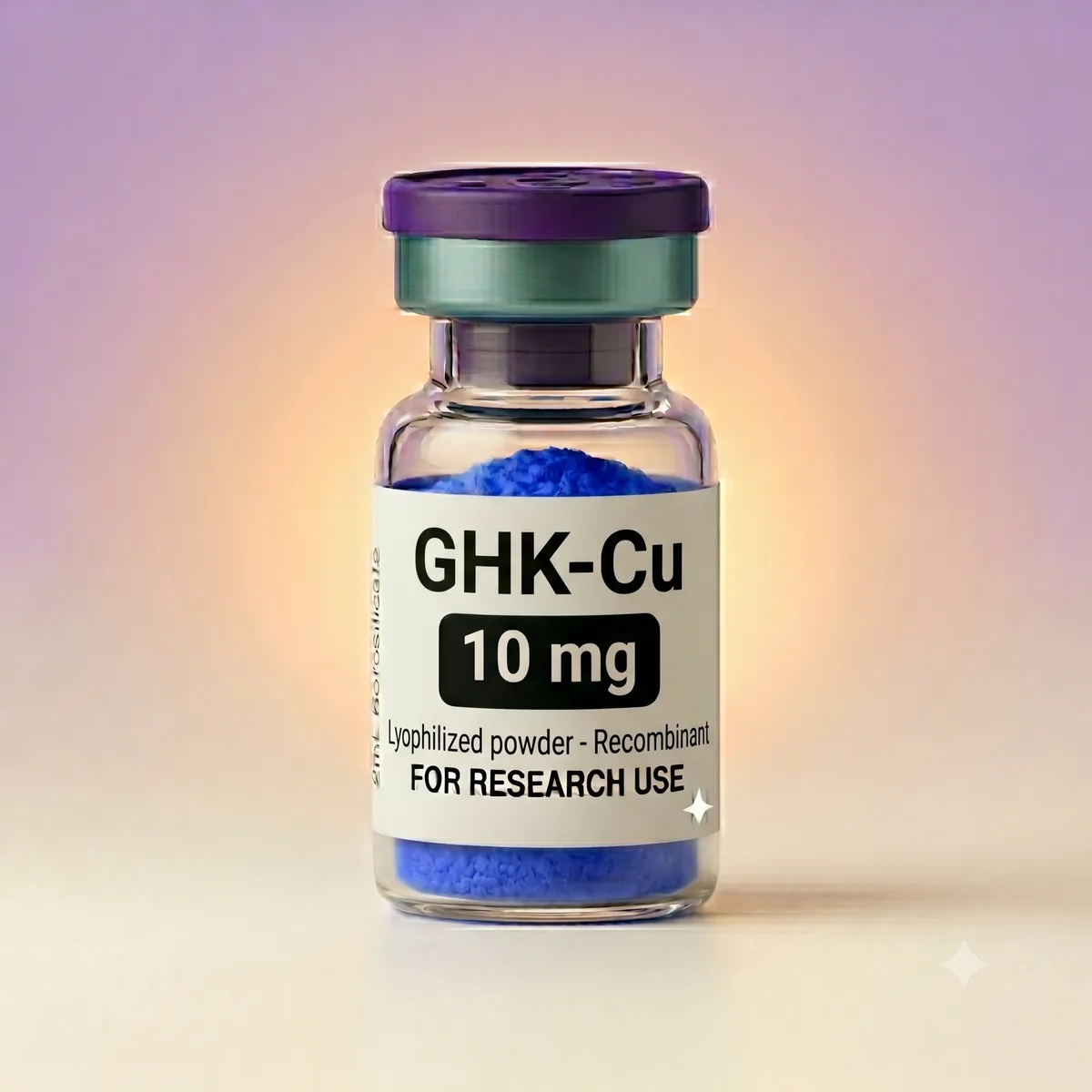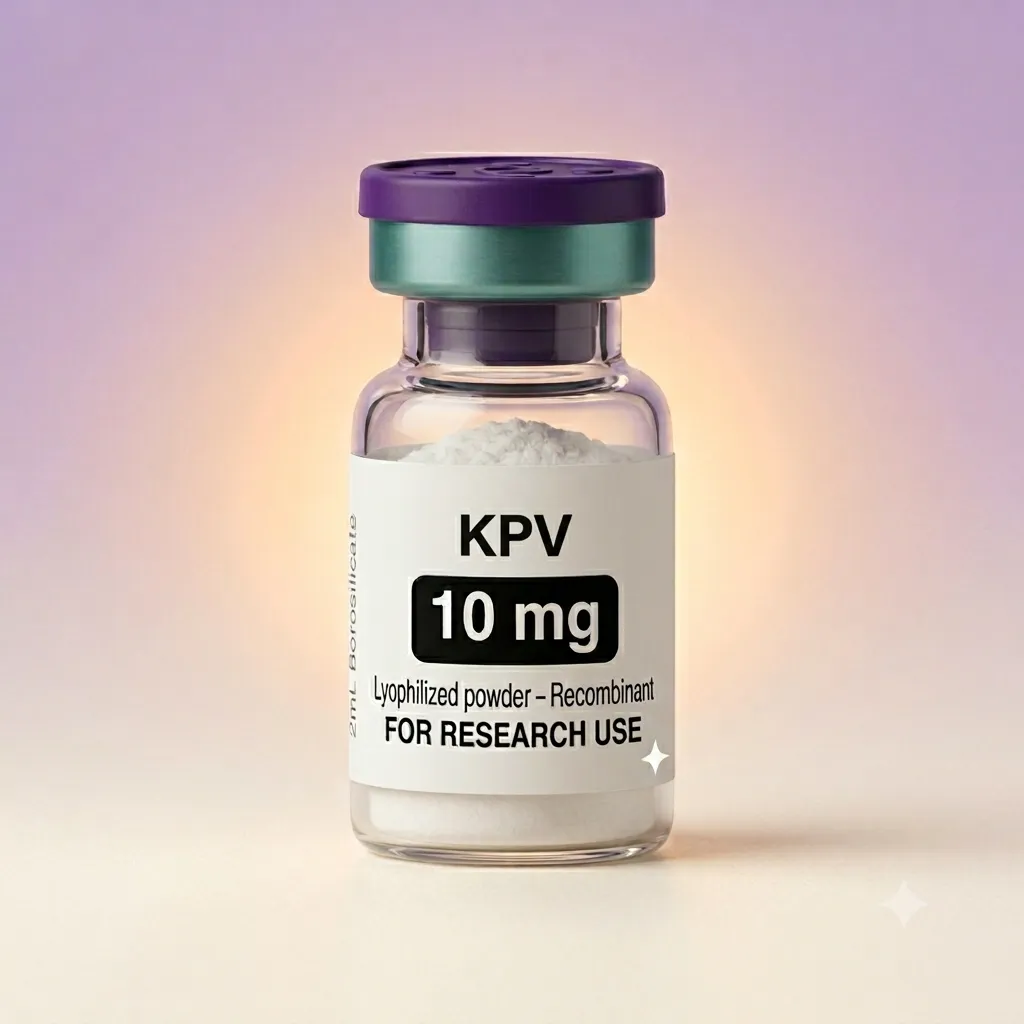
Lyophilisation removes water, the medium in which a peptide's main degradation routes occur. That is why lyophilised material tolerates conditions the reconstituted form does not, and why the critical point of the cold chain shifts to the period after reconstitution.
Why are peptides lyophilised?
Lyophilisation, or freeze-drying, removes water from the sample by vacuum sublimation after prior freezing. The result is a dry powder retaining the compound's structure.
The underlying reason is that water is the medium in which a peptide's main chemical degradation routes occur. Removing it drastically lowers molecular mobility and reaction rates fall by several orders of magnitude.(2)
What are a peptide's degradation routes?
The protein and peptide stability literature describes several mechanisms, all accelerated by the presence of water, temperature and oxygen.(1)
| Route | What happens | Accelerating factors |
|---|---|---|
| Hydrolysis | Cleavage of the peptide bond by water. | Humidity, temperature, extreme pH. |
| Oxidation | Modification of sensitive residues such as methionine, cysteine and tryptophan. | Oxygen, light, trace metals. |
| Deamidation | Conversion of asparagine and glutamine, with a change in charge. | Water, temperature, alkaline pH. |
| Aggregation | Association of molecules into larger species. | Concentration, agitation, air-liquid interface. |
All four routes share a denominator: the availability of water and the molecular mobility it permits.
Which storage conditions does the literature describe?
Conditions depend on the state of the material, and the difference between the two states is considerable.
| State | Condition | Relative horizon |
|---|---|---|
| Sealed lyophilised | Freezing, around −20 °C | Prolonged storage. |
| Sealed lyophilised | Refrigeration, 2 to 8 °C | Intermediate periods. |
| Sealed lyophilised | Room temperature | Limited exposure, compatible with transit. |
| Reconstituted | Refrigeration, 2 to 8 °C | Substantially shorter shelf life. |
The relevant jump occurs in the last row. Reconstitution reintroduces water and with it every route described above. The critical storage point is not the shipment, but the period after reconstitution.
Does shipping without continuous refrigeration compromise the material?
Not necessarily. The lyophilised form is designed precisely to tolerate transit without continuous refrigeration, and that tolerance is what makes international trade in these compounds viable.
What cannot be established without analysis is the state of the material after prolonged transit under unknown conditions. A certificate issued at origin months earlier describes the batch as it left the plant, not as it arrived. This is the technical justification for analytical verification on material received at destination, covered in the article on double purity verification.
Which handling practices are described as adequate?
- ✓Light protection: the vial is kept in its original packaging, since light exposure promotes oxidation.
- ✓Avoiding thermal cycling: repeated freezing and thawing stresses the material and increases aggregation.
- ✓Reconstitution without vigorous shaking: diluent runs down the inner wall and dissolution completes by gentle rotation.
- ✓Humidity control: lyophilised powder is hygroscopic, so the vial should not be left open.
- ✓Date recording: noting the reconstitution date allows tracking the use period.
Which signs suggest compromised material?
Visual inspection has limited but non-zero value. Certain indications justify not using a vial.
Visual indications
- Lyophilised cake collapsed, melted or irregularly adhered to the vial wall.
- Colour change from the usual white or slightly translucent appearance.
- Turbidity or visible suspended particles after reconstitution.
- Compromised seal or stopper, or evidence the vial had been opened.
The absence of these indications does not guarantee integrity. Chemical degradation can occur without visual manifestation, which is why visual inspection complements analysis rather than replacing it.
References
- Manning MC, Chou DK, Murphy BM, et al. Stability of protein pharmaceuticals: an update. Pharm Res. 2010;27(4):544-575. DOI: 10.1007/s11095-009-0045-6.
- Wang W. Lyophilization and development of solid protein pharmaceuticals. Int J Pharm. 2000;203(1-2):1-60. DOI: 10.1016/s0378-5173(00)00423-3.
- Chang BS, Kendrick BS, Carpenter JF. Surface-induced denaturation of proteins during freezing and its inhibition by surfactants. J Pharm Sci. 1996;85(12):1325-1330. DOI: 10.1021/js960080y.